
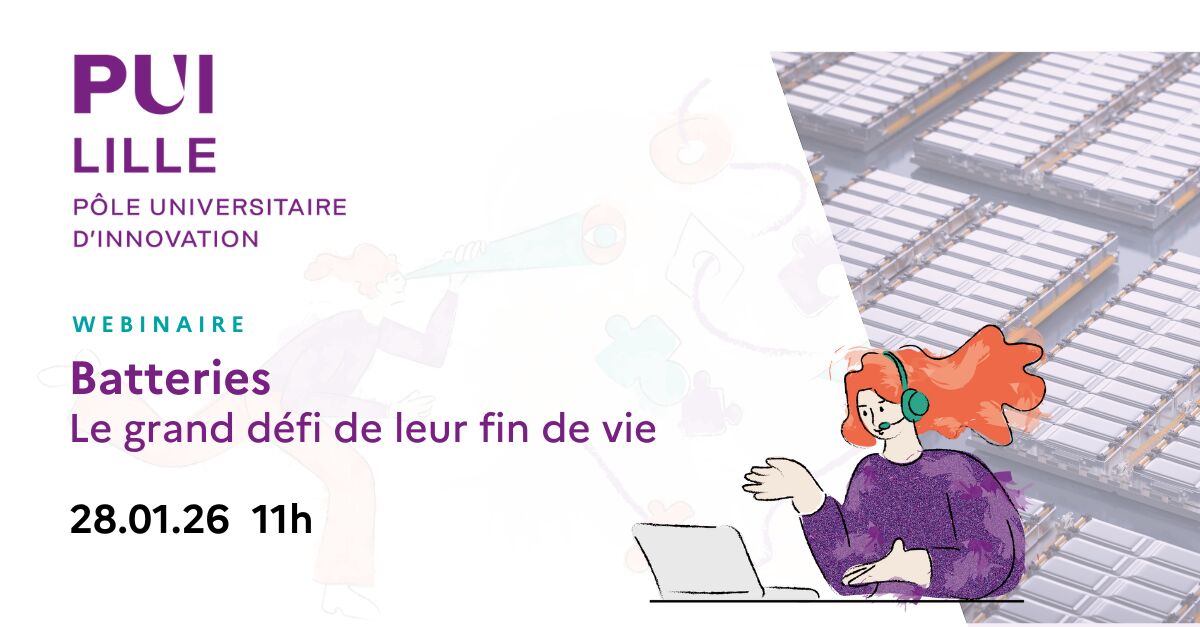
The second life of batteries: a technological challenge... and a tremendous scientific opportunity!
Batteries have become an invisible pillar of our daily lives: electric mobility, energy storage, electronics, networks.
But one question is now coming to the fore: what do we do with batteries at the end of their first life?
Beyond the environmental issue, the second life of batteries is above all a complex scientific and technological problem that cannot be solved with slogans or ready-made solutions.
This is precisely what we will explore during the webinar on January 28—“Batteries: the great challenge of their end of life” 👉
🔗 https://lnkd.in/eqb8hAME
🔬 A used battery is never a “standard” battery
Batteries are often referred to as homogeneous objects. In reality, each end-of-life battery is a special case:
– chemistry (LFP, NMC, NCA, etc.),
– usage history (fast charging, cycling, temperature),
– non-uniform electrochemical aging,
– latent defects invisible to the naked eye.
This is where science becomes essential.
1. Diagnose the actual state of health.
👉 Spectroscopy, electrochemical modeling, artificial intelligence, advanced estimation methods.
2. Understand the mechanisms of aging (calendar vs. cyclic, electrode degradation, formation of parasitic layers, risks of thermal drift)
👉 For a second life without industrial risk.
3. Adapt uses to the actual condition of the batteries
Not all batteries are good for everything.
👉 Usage, charge profile, and physical-chemical condition must be matched.
Collaboration with research laboratories is strategic for companies:
– access to advanced characterization methods,
– predictive life models,
– instrumented test benches,
– independent expertise to secure industrial choices.
💡 The second life of batteries is a typical area for co-innovation:
– the company provides the real-world case,
– the laboratory provides in-depth understanding and validation tools.
And when a second life is no longer relevant: smart recycling, with its scientific challenges (material separation, energy optimization of processes, recovery of Li, Ni, Co, Mn, etc., sober and circular processes).
👉 Here again, materials chemistry, catalysis, and process engineering are at the heart of the solutions.