
SATT Nord announces the signing of an exclusive license to exploit Bioversight technology for the benefit of the startup Elidreo, which specializes in innovative environmental monitoring tools dedicated to the detection of chemical and microbiological pollution.
This transfer marks a major step forward in the protection of aquatic environments and the assessment of water quality, issues that are central to public environmental policy.
Water is a resource that is essential to life. Human activities (transportation, industry, agriculture, hospitals, domestic use, etc.) cause numerous types of pollution that can affect biodiversity and human health. Protecting water resources is therefore a major challenge based on:
- Maintaining biodiversity and ecosystem services,
- An increasingly strategic approach to water reuse.
In industrialized countries, conventional water quality is based on analyses carried out according to well-established standards based on regulations (EU, France), via drinking water and wastewater treatment networks. Manufacturers, for their part, must guarantee the safety and compliance of discharged water with established standards.
Today, analytical laboratories mainly use physical-chemical and microbiological approaches. However, these approaches have certain limitations, not only related to the nature of this matrix, but also to the risks of toxic contaminants being present, which are difficult to trace.
This is why there is growing interest in the use of biota (living organisms present in a biotope) as a biomonitoring tool. Indeed, the use of biological organisms (mollusks, invertebrates, etc.) as sentinels of water quality appears to be a technological alternative capable of addressing these limitations, by providing information that is not available through physicochemical approaches (toxicity, bioavailability).
Innovative technology to address the challenges of water pollution
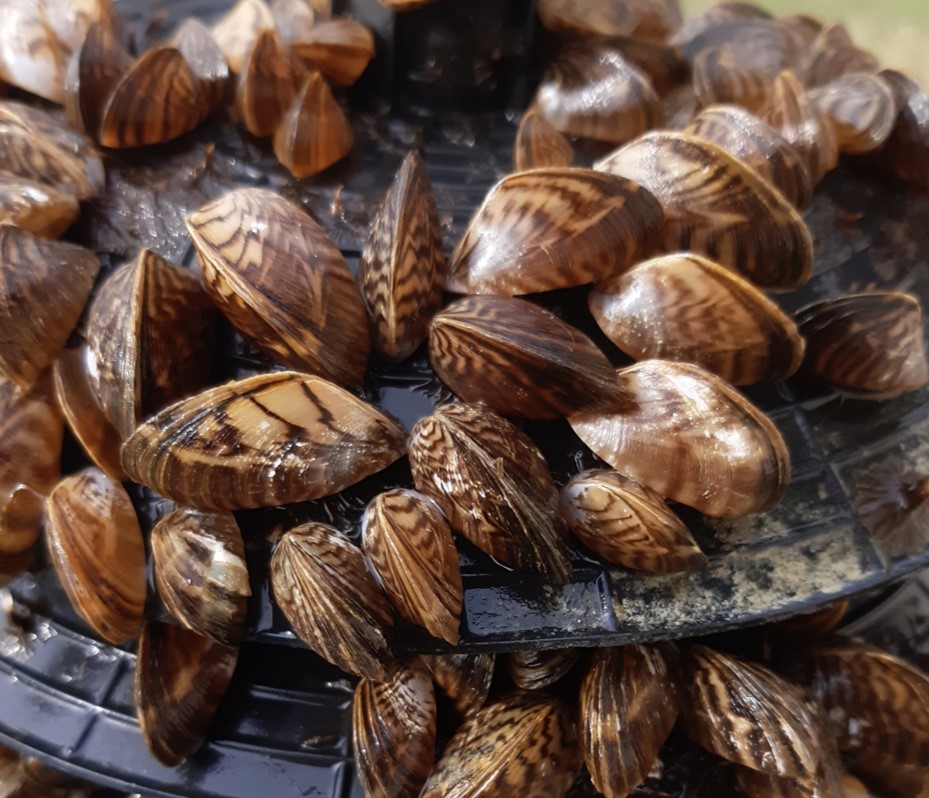
BIOVERSIGHT technology is a biomonitoring solution that uses dreissenids (zebra mussels, bivalve mollusks) as sentinel species, recognized as being particularly effective for monitoring biological contaminants in aquatic environments.
This standardized, easy-to-use diagnostic tool will help water managers and industrialists prevent risks associated with water quality degradation by identifying pollution levels for a wide range of chemical contaminants (metals, pesticides, PCBs, hydrocarbons, etc.) and microbiological contaminants (bacteria, viruses).
It will complement the more traditional measurement tools offered by specialized analysis laboratories (micropollutant testing) and solutions developed in recent years using biota as bioindicators, and could be used in other study contexts such as the assessment of water intended for purification, reuse, or even for studies on the impact of discharges from wastewater treatment plants.
A project resulting from 10 years of research in aquatic ecotoxicology
This project was developed by researchers from the Environmental Stress and Aquatic Environment Biomonitoring Unit (UMR-I 02 SEBIO) at the University of Reims Champagne-Ardenne / INERIS / Le Havre, which has been conducting research in aquatic ecotoxicology for over 10 years.
The SEBIO laboratory is positioned as a unique structure in France in the field of environmental science research, enabling it to participate in large-scale national and European programs (H2020, Interreg, ANR-I, PIA3) aimed at proposing innovative solutions and structuring thinking on the bio-assessment of ecotoxic impacts on water bodies.
The team, which includes Dr. Mélissa Palos-Ladeiro, unit director of the SEBIO laboratory, Prof. Alain Geffard, and Dr. Audrey Catteau, researcher at the UMR-I 02 SEBIO unit, specializes in studying the toxic effects of emerging contaminants (chemical and biological) and in developing various tools (bioassays, biomarkers, ecotoxicity models, biological indicators).
Strong support from SATT Nord for the development of the Bioversight project
SATT Nord contributed to the progress of this project with total funding of €171,500.
This funding made it possible to obtain a standardized model of dreissenids and to recruit a development engineer, Audrey Catteau, who, through various tests, succeeded in demonstrating the effectiveness of the dreissenid bioassay for monitoring certain microbiological targets.
This development was carried out in collaboration with SEDIF (Syndicat des Eaux d’Ile-de-France), which opened its site and made its water data available, and ACTALIA, which contributed its expertise in microbiological analysis.
SATT Nord, in partnership with the Innovact / Quest For Change incubator, also provided support for the project in terms of entrepreneurial aspects.
In this context, the future startup received a French Tech Lab grant from Bpifrance, which helped finance, among other things, support for the team in structuring the entrepreneurial project, developing its strategic roadmap for market launch, and its customer prospecting plan.
Since its creation, the startup has been supported by the InnoRem University Innovation Cluster at the University of Reims Champagne-Ardenne, which facilitates meetings with key players in innovation, promotes its integration into events within the entrepreneurial ecosystem, and acts as a link for the implementation of hosting solutions and research collaborations.
"With this license agreement, we are once again demonstrating the ability of laboratories in the region to produce innovative solutions to environmental challenges. This is precisely the mission of SATT Nord: to transform research results into concrete solutions for local areas." Frédéric Grimbert, Director of Grand Est Relations, SATT Nord.
Elidreo: a startup committed to environmental monitoring
Elidreo will develop, industrialize, and market the BIOVERSIGHT solution, drawing on its expertise in aquatic biomonitoring and its mastery of standardized bioassays using zebra mussels. The company plans to standardize the bioassay within AFNOR and will continue its scientific development in partnership with the University of Reims Champagne-Ardenne via the SEBIO laboratory, in order to strengthen the robustness and broaden the applications of the method. Its ambition is to accelerate access for water managers to sensitive, robust, and operational solutions to meet the growing challenges of water quality.