
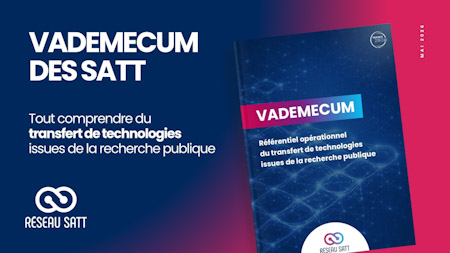
SATT Handbook: Everything You Need to Know About Technology Transfer

More than twelve years after their founding and drawing on their experience, […]

More than twelve years after their creation and drawing on their extensive experience, the SATTs have published their Vademecum, a comprehensive operational guide to the transfer of technology derived from public research. This collection of experiences, methods, and operational tools provides insight into their unique model for fostering innovation and establishes common benchmarks for the entire deep tech ecosystem. Origins, missions, licensing, maturation, startups, impact… This Vademecum is the go-to resource for everything you need to know about the SATTs.

Transparency and Clarity of SATT Activities

SATTs are strategic players in the French innovation landscape, operating at the intersection of academic research and the market. They take risks, secure funding and make investments, organize projects, support scientific teams, engage with industry and their ecosystem partners, and then transfer projects in accordance with the strategy developed by their teams and researchers. Today, they demonstrate exemplary results in fulfilling their missions, thanks to effective, hands-on support and recognized expertise in transforming innovations into socioeconomic impact.

As the concept of efficiency takes center stage in the research community, the SATT Network aims to serve as a catalyst and connector within the national innovation ecosystem. This Handbook is part of an effort to clarify, harmonize, and consolidate practices. Commissioned by the National SATT Management Committee, it addresses the need for consistency in carrying out the missions of transferring and supporting innovations stemming from public research.

It serves a dual purpose:

  • To foster cohesion between SATT teams and research institutions, ensure best practices, facilitate the sharing of experiences, and support technology transfer professionals in their day-to-day work and in their interactions with all staff members of the University Innovation Hubs (PUI).
  • Enhance the clarity and transparency of SATTs’ activities, both internally and toward stakeholders: researchers, higher education and research institutions, industrial partners, innovation ecosystem actors, investors, and public authorities.

This handbook aims to organize and clarify these elements, formalize shared practices, and provide auseful framework for collective operations, while taking into account specific organizational and regional characteristics. It also serves as a tool for SATT professionals, designed to support their practices and foster a shared understanding of the current situation.

A Framework for Technology Transfer

The purpose of this handbook is to clarify roles and responsibilities, harmonize practices where appropriate, and provide partners with a common, understandable, and practical reference point. It also aims to make the added value of SATTs in the technology transfer chain more transparent by highlighting their role as a bridge between academic research and the market.

From a methodological standpoint,the development of the Vademecum is based on a participatory and collaborative approach. It combines a synthesis of work already conducted within the SATT Network (white papers, activity reports, comparative analyses) with the collection of operational practices and feedback from SATTs. It also draws on external references—at the national, European, and international levels—to ensure a comparative perspective with other Technology Transfer Offices (TTOs) and consistency with current standards. External contributions (MESRE, ANR, DGE, SGPI, industry stakeholders) have enriched the report as a whole, thereby strengthening its relevance and operational grounding.

This handbookhighlights the wealth of experience among SATTs, showcases the network’s ability to establish a common framework, and reinforces their role as key and recognized players in technology transfer, both in France and internationally. It is organized in a step-by-step manner, ranging from the fundamentals of the system to the measurement of value created. This structure helps readers understand how SATTs fit into the public research value chain, from the scientific upstream phase through to economic and societal impacts.


EXPLORE THE HANDBOOK