
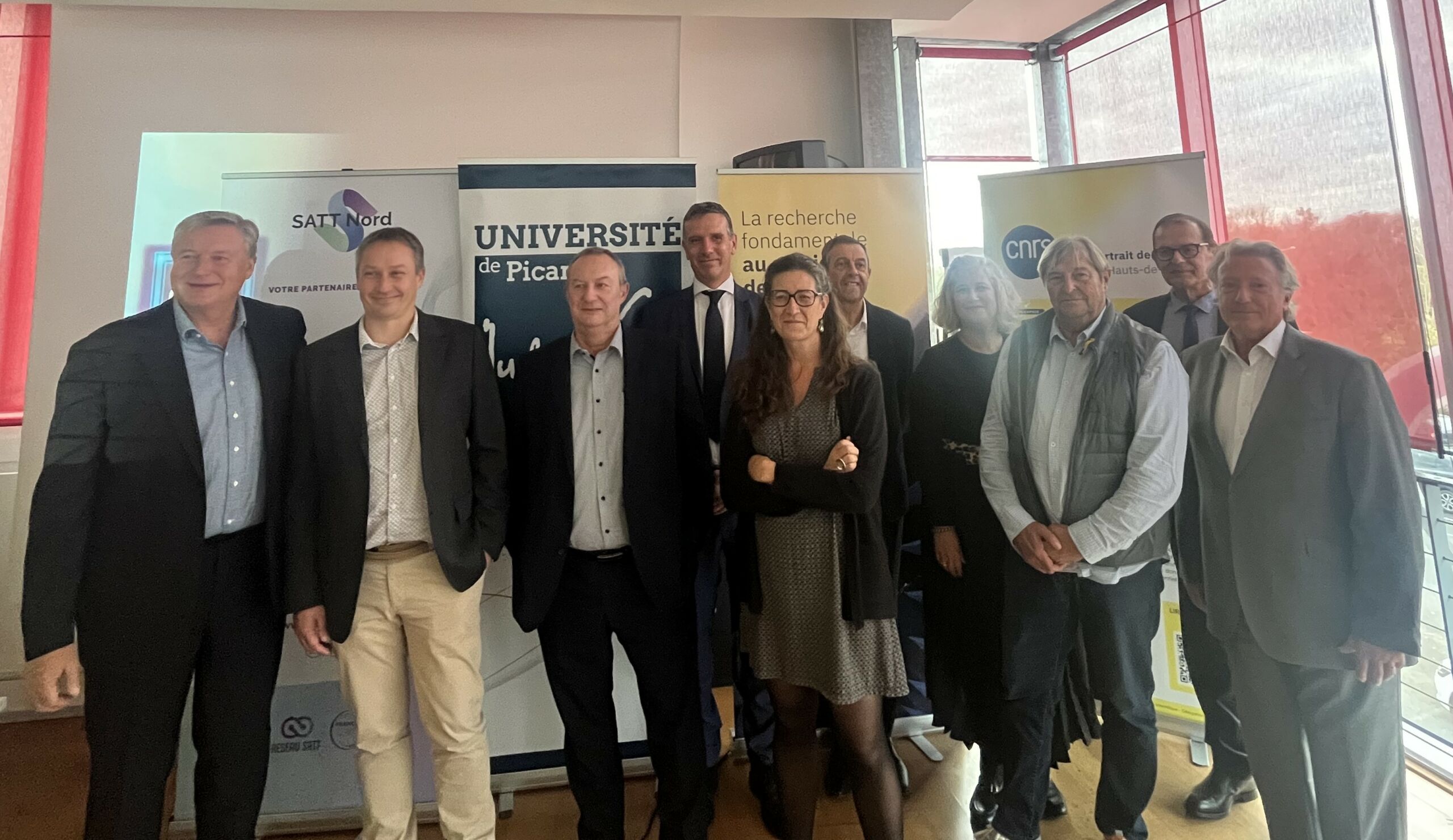
An exclusive license agreement has been signed between SATT Nord and the startup CRYSTAL Energy the result of ten years of research at the University of Picardie Jules Verne and the CNRS for the development of a new breakthrough photovoltaic technology that brings a new functionality to all types of glass: the production of green electricity while remaining completely transparent and colorless to the human eye.
A promising collaboration for photovoltaic and glass innovation in France:
SATT Nord and startup CRYSTAL Energy have signed an exclusive license agreement for the development of a breakthrough photovoltaic technology. The result of ten years of research conducted at the University of Picardie Jules Verne and the CNRS, this innovation brings a new functionality to all types of glass surfaces: transparent absorbers that generate green electricity without altering the aesthetic appearance of the glass. Glass is a versatile material that plays an essential role in many sectors, including electronic devices, street furniture, housing, vehicles, and construction. Making glass capable of producing electricity without altering its optical properties opens up new possibilities. One example is the construction industry. Buildings consume one-third of the energy produced and are responsible for 40% of greenhouse gas emissions. Reducing this significant footprint is an environmental emergency and is fully in line with the move towards zero-energy or positive-energy buildings.
In one hour, we receive enough energy from the sun to power the entire world for a year. The mass industrialization of silicon panels in Asia has significantly transformed the energy industry over the past decade, making solar energy increasingly competitive and accessible. However, to achieve our targets of 42.5% renewable energy production by 2030 and carbon neutrality by 2050 (i.e., 100% renewable energy), disruptive innovations are needed, particularly those that increase integration possibilities while ensuring that they fit into the landscape and are accepted by society.
It is in this context that the team led by Frédéric Sauvage, CNRS research director and co-founder of CRYSTAL Energy, has developed a new disruptive technology: a transparent, colorless, electricity-generating glass that can be integrated into double glazing. This innovation, which works in a biomimetic way, is inspired by the natural photosynthesis of plants, producing electricity from an invisible synthetic absorber. Just like nature, the system works very efficiently, avoiding the use of critical and/or toxic materials and being very frugal in its use of materials (20mg of absorbers perm² of glass).
The feat achieved by the LRCS photovoltaic team, led by Frédéric Sauvage, was to create synthetic pigments capable of selectively capturing near-infrared light, which is invisible to the naked eye. The result is a colorless, transparent photovoltaic glass with an average transmittance of over 80% and a color rendering index (CRI) of 96, equivalent to conventional double glazing.
The results obtained are very promising: one square meter of glazing can produce 35Wp, while providing a high level of sound attenuation and thermal comfort. Ongoing R&D work on the technology will double electricity production within three years.
There are many applications for electricity-generating glass. Any glass around us could become a source of electricity in the future. In the building sector, the trend toward urban densification and vertical construction with windows and glass surfaces offers considerable development opportunities for electricity-generating glass.
"As soon as it was presented to our team in 2021, the TRANSITION project generated a lot of interest! It was therefore quickly decided to support Frédéric Sauvage in his search for funding and his IP strategy. The project now benefits from a €408,000 investment from SATT NORD to consolidate the stability of the molecules over time and work on scaling up the solution. A first1m2 demonstrator should be ready shortly. We are convinced that this technology will transform our vision and our use of tomorrow's glazing. For this promising innovation, SATT NORD has also decided to support the design phase of the start-up CRYSTAL ENERGY, the licensee of the technology, by acquiring a stake in its capital. We are fulfilling our role as an early-stage investor dedicated to academic research."Audrey Giros, Head of the Planet and SNI Business Unit.
"Thecreation of Crystal Energy is fully in line with the strong momentum for promoting and transferring innovations resulting from research carried out by the Laboratory of Reactivity and Solid State Chemistry (LRCS), a research unit of the University of Picardie Jules Verne and the CNRS. It is partly the result of close collaboration between the various players involved in research and promotion: UPJV, CNRS, CNRS Innovation, and SATT Nord. The signing of the licensing agreement between SATT Nord and Crystal Energy reflects the reality of this structuring partnership, which allows a great innovation, the result of excellent public research, to materialize through the creation of a startup that provides solutions to major societal challenges." Damien Cuny, Provisional Administrator of UPJV
"This signature on the patent license agreement with the spin-off CRYSTAL Energy crystallizes both the best that French researchers can produce and the unfailing support of the CNRS for excellence in research and innovation. It also illustrates our collective ability, in collaboration with our partners, to transform scientific discoveries into concrete solutions for sustainable, green, and accessible energy." Vanessa TOCUT, CNRS Regional Delegate for Hauts-de-France
CRYSTAL Energy: when the invisible revolutionizes energy
Transforming glass into a source of clean electricity: this is the revolution brought about by CRYSTAL Energy. By integrating invisible and affordable light converters, our patented innovation meets the needs of key sectors such as construction, public infrastructure, and displays.
Developed by the CNRS, it is designed for local, responsible production that is accessible to all. Our product can be adapted to all shapes and applications thanks to innovative industrial processes.
After an initial round of fundraising, our goal for 2025 is to deploy our electrogenic glass technology in real-world conditions and industrialize it with key partners. CRYSTAL Energy: invisible, but indispensable